
Start a Shelby County Search
A fast first stop is the Shelby County Online Assessment Information portal. It accepts an owner name, address, or property number. Addresses make a dependable first key. Streets vary less than names. Once the right result opens, copy the parcel number and the legal description that anchor the search to the land itself. A mailing address can differ from the site address, and street forms change over time.
Then check the Recorder's document index for the newest deed. Compare the tax figures and the map next. A parcel is a mapped unit used for assessment. It may not match the land in an old deed after a split or a combination. Boundary surveys and certified title work are separate jobs.
- Search XSoft by the street address and open the matching parcel card.
- Record the owner, full APN, legal description, and result's data-current date.
- Use the owner and legal description in the Recorder's Doxpop index to locate the latest deed.
- Check the Treasurer list for the tax year and payment context, then inspect the parcel in WTH GIS.
- Ask the custodian for a certified copy or an older office record when the web trail stops.
Note: A search result is a starting point toward an official record, not a guarantee of title or a legal boundary.
Where Shelby County Keeps Records
Each office holds one piece of the file. The Recorder keeps deeds, mortgages, liens, leases, surveys, and subdivision plats. The Assessor values parcels and publishes the property card. The Auditor handles roll ownership and deductions. The Treasurer collects the bills. Timing gaps matter, because a recent deed can appear before the assessment roll updates and Shelby County publishes no fixed closing-to-roll delay, so compare the roll with the latest matching deed for present ownership.
Shelby County Treasurer
25 W Polk St, Room 102
Shelbyville, IN 46176
317-392-6375
XSoft Connects Shelby County Records
An assessor result goes beyond an owner list. Tabs can connect Summary, Land, Residential, Improvements, Sketches, Photos, Tax, Sales, Documents, Appeals, Forms, and Map information. Record fields cover the ownership name, mailing and situs addresses, township and district, land and improvement values, acreage, legal description, transfer history, and sketches. One habit pays off. Copy the result's own data-current date. The landing screen and the individual record can show different snapshots.
| Owner mode | Last or business name, with first name and optional middle initial |
|---|---|
| Address mode | House number, street, city, ZIP, and optional unit |
| Property mode | Parcel number or alternate property number |
| Result check | Match situs address, APN, township, district, and legal text |
The sample Shelbyville result shows a property-number search narrowing to one parcel. The full card opens from there.
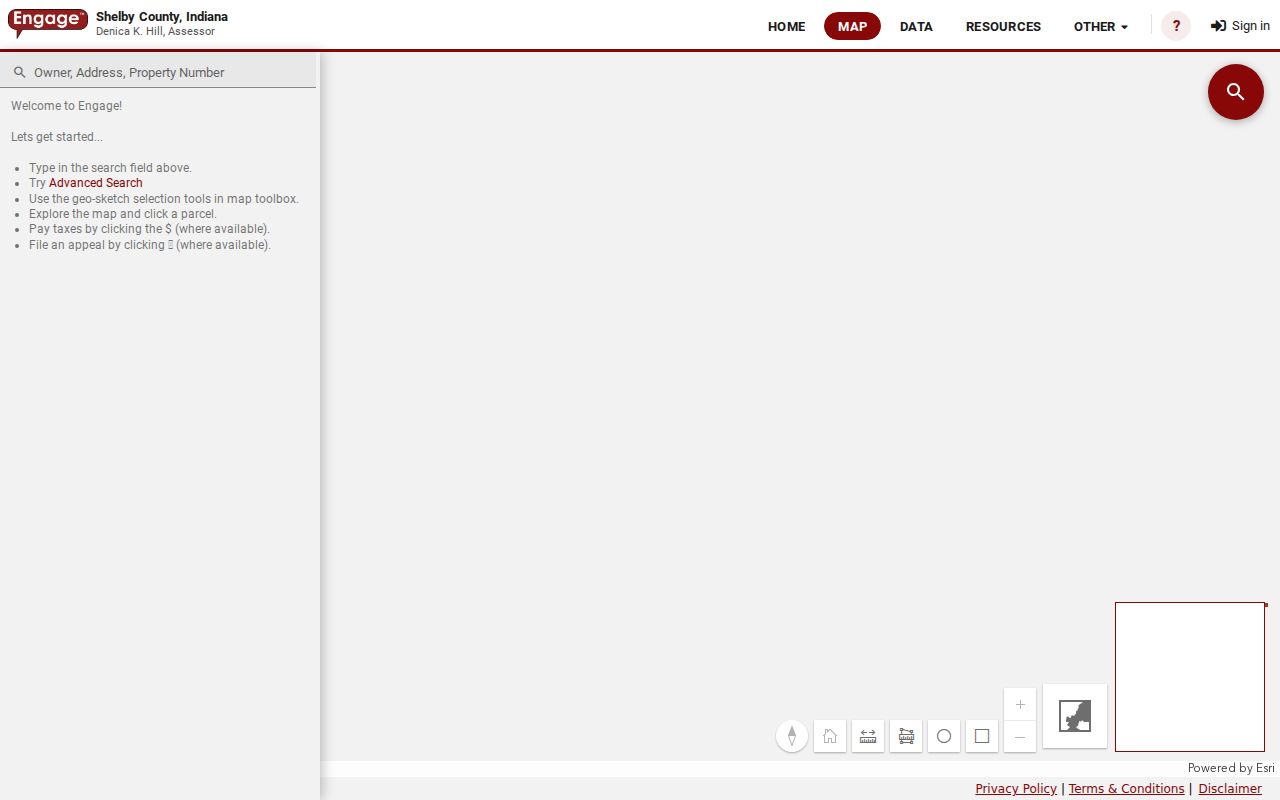
Use the screen as a reference only. Verify the live card, since assessment data can change.
Deeds Cross the 1998 Divide
Shelby County's coverage overlaps. Recorder guidance puts the index books at 1822 through June 1998, with recorded documents available from May 1998 forward. Computer and Doxpop copies date to January 1998. That overlap is a local quirk. When an instrument falls in the transition, ask the Recorder which image, computer record, or book controls.
Earlier work needs the counter. The Recorder searches pre-1998 material by hand. The Indiana State Library microfilm guide and FamilySearch Catalog 16334 extend research into nineteenth-century deed books. An exact transfer date from the Auditor can save time before a manual request. The fuller chain method appears in Shelby County deed records.
Property Watch Adds Shelby Alerts
Doxpop Property Watch sends recording alerts. A user registers names or legal-description terms. The user then receives notice when a matching document is recorded. It is an alert service rather than a title service. The Recorder does not control it. An unexpected notice should lead to the actual instrument and, where needed, legal advice.
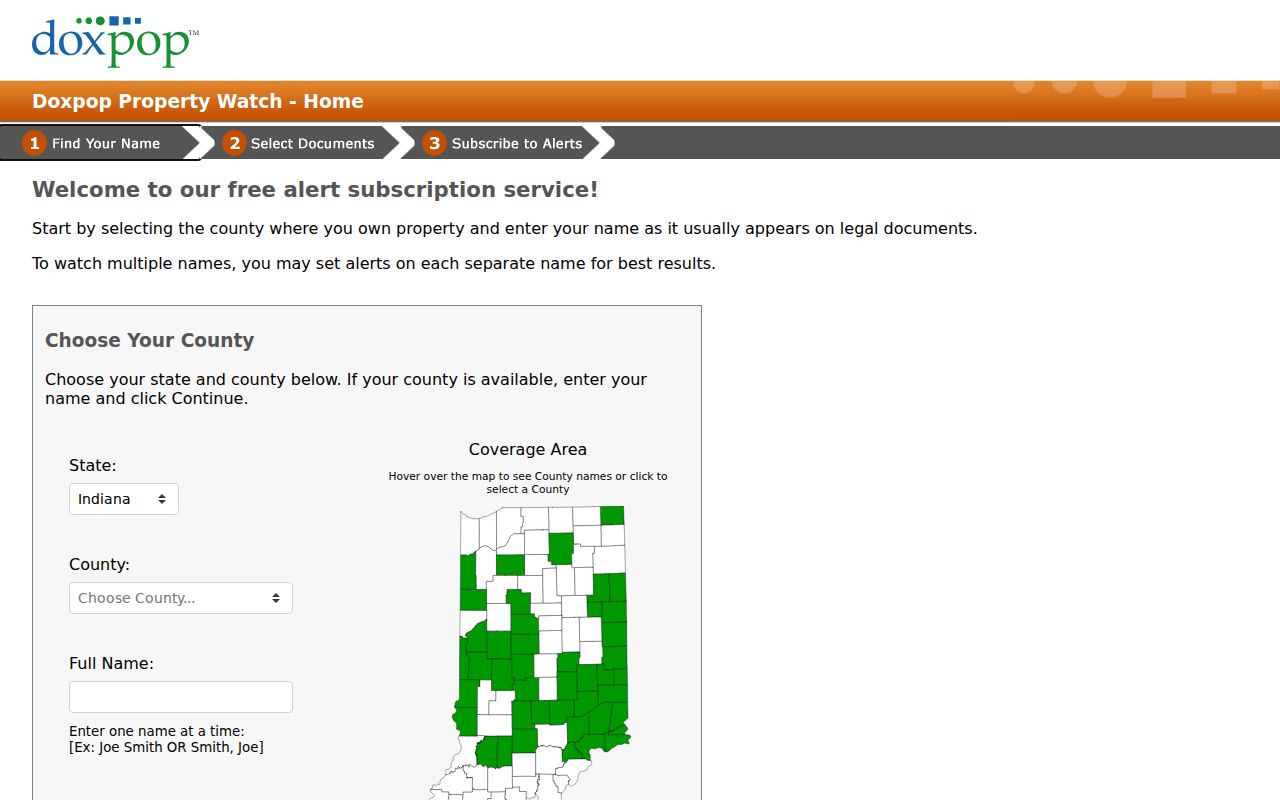
The signup screen shows the monitoring route. An alert alone proves no fraud, ownership, or legal effect of a filing.
Shelby County Property Record Types
No single database holds the whole land story. Recorded instruments show transfers and claims. Assessment and tax systems carry the county's administrative view, while maps organize parcels in space and court or city files can explain disputes and development work.
| Record Type | What It Documents | Kept By | Access |
|---|---|---|---|
| Deeds and related filings | Transfers, parties, dates, legal descriptions, liens | Recorder | Doxpop, counter, mail, copy request |
| Assessment cards | Roll owner, parcel traits, land and improvement values | Assessor and Auditor | XSoft and office service |
| Tax records | Tax year, bill, payments, deductions, delinquency clues | Auditor and Treasurer | Tax list, warning list, office |
| Parcel and plat records | Mapped parcel, APN, lot or legal-description context | GIS and Recorder | WTH viewer, recorded plats, library |
| Permits and zoning | City work, applications, zoning and land-use review | Shelbyville Planning | Citizenserve and direct request |
Use the recorded deed for vesting language. Use the tax card for assessed figures. A plat or survey supports boundary research. Court cases may add foreclosure, partition, quiet-title, lien-enforcement, or probate context, and MyCase and Odyssey are public starting points, though older files and some images still require the Shelby County Clerk.
Map Shelby County Parcels Carefully
The WTH GIS viewer supplies the spatial side of a Shelby County property search. A user can locate a parcel, identify it, and read the information pane. Information pages follow. An identified list can export to Excel. Custom search adds Owner Name and Sales options. Filters cover sale date, price, neighborhood, class, and acreage, but the viewer publishes no named layer catalog, buffer tool, or county open-data download.
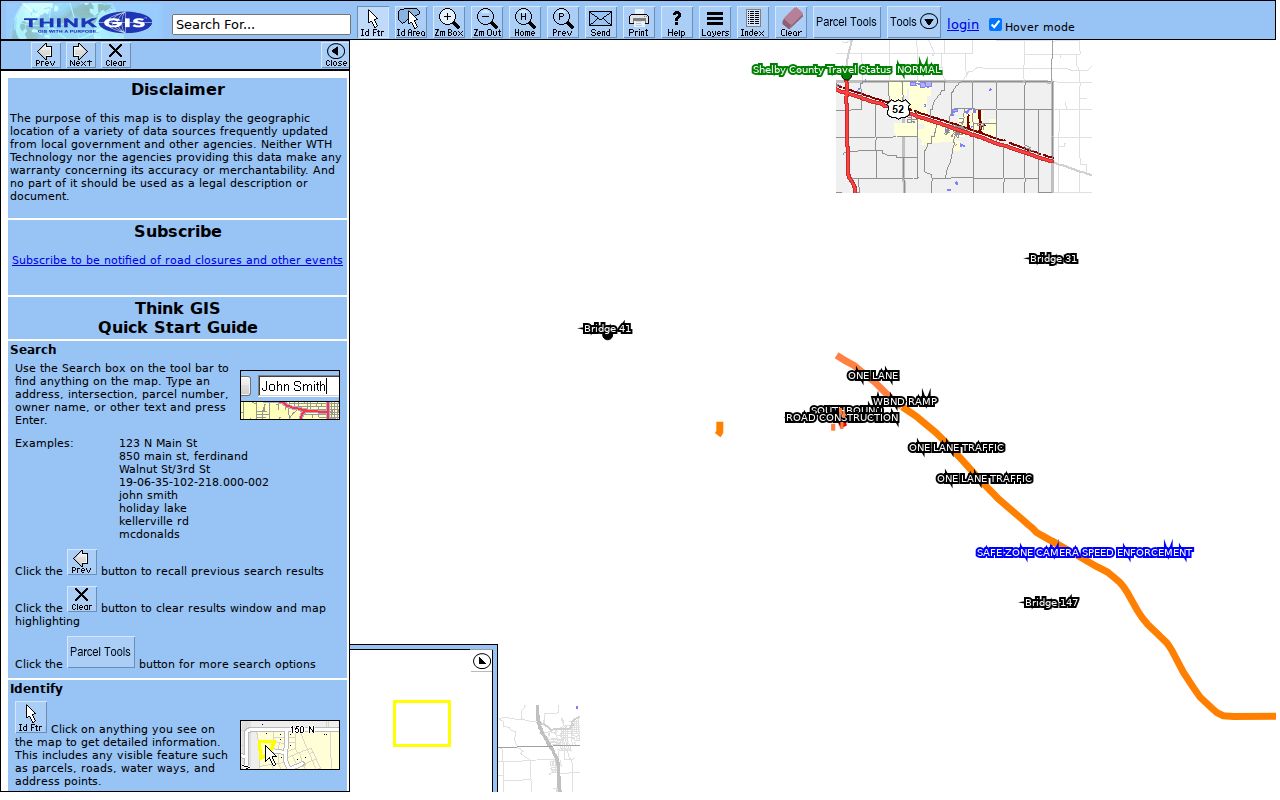
The viewer's screen helps locate the information controls. Its parcel lines are reference graphics, not a new boundary survey.
- APN
- The assessor's parcel number, kept in full with punctuation.
- Situs address
- The location of the land, which may differ from the tax mailing address.
- Plat
- A recorded drawing that organizes lots, blocks, streets, and other features.
- Grantee
- The party receiving an interest in a deed.
Shelby Taxes Use Three Offices
Three Shelby County offices divide the tax job. The Assessor sets assessed values. The Auditor moves ownership and deduction work into the tax roll, and the Treasurer then bills and collects. Its public list searches by district, parcel number, owner name, tax year, or property address, and it returns more than 35,000 rows, so the parcel detail runs deep. Narrow the fields too far, though, and a valid parcel can drop out of the results.
A parcel split or combination from the last two years may be easier to trace by owner surname. Follow up with the Treasurer directly. Warning results deserve a second look. The list itself is not for official use. Before a closing, appeal, or tax-sale decision, confirm payment status with the office and check the deed records behind the parcel number.
Indiana Shapes Shelby Assessments
Indiana assesses real property at 100 percent of market value-in-use. That standard is not one open-market sale price. DLGF guidance applies annual trending and a four-year physical inspection cycle, so about a quarter of parcels get reviewed each year. The parcel card keeps land and improvement values separate. It then reports a single total. Exemptions and deductions affect taxable liability, not what a deed says.
Disputes start with the county process and Form 130. Appeals can then reach PTABOA and the state. Record the assessment year, the card's data-current date, photographs, measurements, and comparable evidence, because a tax bill and an assessment record answer different questions.
Shelbyville Adds a City Layer
County offices still hold the deeds, assessments, taxes, and parcel maps for Shelbyville. The city adds its own layer. Permits, inspections, code enforcement, zoning, contractor registration, and Plan Commission or BZA records all live at the city level. Citizenserve's public portal lists land-use applications, permits, business licenses, search, and reports. The full field list sits behind a login. Boundaries and tax timing need care. Project Hackman involves 13 parcels east of Shelbyville near Highway 44 and 325 East. The 2026 resolution sets a first assessment in 2027. First city taxes arrive in 2028. That staged schedule means a county parcel map, a Shelbyville zoning record, and a later city-tax bill can all matter at once. More detail sits on the Shelbyville property records page.
Early Shelby Deeds Still Survive
Shelby County's paper trail of land runs deep. FamilySearch holds deed books covering 1822 through 1886. The Indiana State Library preserves county microfilm and finding aids. The Shelby County Public Library adds local directories, newspapers from 1853, obituary books from 1850 to the present, plat maps, and more than 3,500 family and local-history folders.
These sources can surface an old street form, an heir, a transfer date, or a subdivision clue. Treat them as leads, not proof. A directory may name a resident and an occupation without establishing ownership. An obituary suggests heirs. It replaces no probate order or executor's deed. Route every clue back to the Recorder's instrument or the Clerk's case file. Grover Museum's Streets of Old Shelby exhibit, centered on 1900 to 1910, adds useful context for matching historic scenes to later parcel research.
Shelby Court Records Affect Land
Court cases can break a clean deed chain. Foreclosure, quiet title, partition, mechanic's-lien enforcement, tax disputes, and probate each interrupt a simple transfer in Shelby County. Indiana MyCase searches by case number, party, attorney, court, type, status, and dates, with wildcard and sounds-like options. Odyssey adds name or case-number routes. County, city, and date-of-birth filters help there. Document access follows Indiana Administrative Rule 9. If an online result lacks the needed pleading, order, judgment, or older file, contact the Shelby County Clerk at 407 S Harrison St, Room 111, Shelbyville, or use the county's searcher records-request route. A docket is the event list. It points to the order that matters, but no docket replaces reading that order itself.
Request Missing Shelby County Records
Indiana's Access to Public Records Act, Indiana Code 5-14-3, backs inspection and copying of public agency records subject to exemptions. Send each request to the office keeping the record. Include the parcel number, names, date range, instrument or case number, record type, and preferred copy format. Ask for a fee estimate before ordering broad scans. Some Shelby County records carry separate limits. Military discharge records face access restrictions. Court records follow Rule 9. Certified birth and death copies require direct interest and proof, protected addresses may be withheld, and the Indiana Address Confidentiality Program supplies substitute addresses to eligible protected people. Do not fill a missing public address from an unverified commercial source.
Limits of Shelby County Records
Shelby County property records can take you far. They show the roll owner, legal-description text, recorded transfers and liens, assessed values, taxes, and a mapped parcel. They have limits. No file proves who occupies a home. It cannot guarantee that every interest was recorded. It does not turn a tax value into an appraisal. Nor does it make a GIS line a surveyed boundary. Update timing differs, so compare sources and keep each record's date.
Lawful use. Use Shelby County records for property diligence, boundary questions, house history, estates, and civic transparency. A records search does not replace title counsel or a licensed surveyor, and owner data must never be used to stalk, threaten, or harass.