
Find Out Who Owns Shelby County Property
Start with a place you know. Turn it into a mapped parcel. Then read the name on the assessment, and finally confirm it against the recorded deed. That chain gives you the owner of record with the least guesswork. Keep the parcel number and the legal description next to the name as you go. Same-name owners and neighboring lots are easy to confuse without them.
- Search the address in Shelby County Online Assessment Information.
- Record the Ownership name, mailing address, situs, APN, and legal description.
- Confirm the parcel visually in WTH GIS.
- Search the grantee and land clues in Doxpop, then inspect the newest deed.
- If an entity owns it, check the exact name in Indiana's official business search.
A recent sale can leave the roll and the deed out of step. When they disagree, ask the Recorder about the instrument and the Auditor about when the roll gets updated.
The Shelby County Ownership Field
The sampled WTH card labels its owner section Ownership. Beneath that label sit the assessment-roll name and a mailing address. The situs shows up elsewhere on the card. That split matters. A mailing address is where the tax bill travels. It is not proof the owner of record lives on the land.
| Card field | How it helps |
|---|---|
| Ownership | Names the assessment-roll owner |
| Mailing address | Gives the correspondence destination |
| Situs | Confirms the property searched |
| Parcel number | Connects assessment, tax, and GIS systems |
| Legal description | Matches the land to the deed |
No Shelby County source publishes a fixed lag between closing and the roll update. Check the data-current date on the individual result instead of assuming every entry was refreshed at once.
Where Shelby County Property Ownership Appears
Shelby County answers the owner question through several official sources. The tax roll gives a fast name. Deed records show the conveyance itself. A GIS map confirms the geography, while a state filing can explain a business name behind a parcel number.
| Source | Owner Info It Gives | Access |
|---|---|---|
| XSoft assessment roll | Owner, mail, situs, parcel details | Public search |
| Recorder / Doxpop | Grantee and latest recorded instrument | Online index and office copies |
| Indiana INBiz | Entity, filing, agent, and status clues | Public state search |
| WTH GIS | Spatial parcel match and card route | Public map |
No Shelby County ownership record proves occupancy by itself.
Confirm the Shelby County Owner by Deed
The Shelby County Recorder is the keeper of the county's land paperwork. That includes deeds, mortgages, liens, plats, surveys, leases, and other instruments tied to land. Its records reach back a long way. Index books span 1822 through June 1998. Recorded documents from May 1998 forward are usually available the next day.
A copy sheet adds a wrinkle. Material from January 1998 forward sits in the computer system, and earlier work remains manual. That overlap matters for transition-era deeds. For one that resists sorting out, call 317-392-6370 or visit 25 W Polk Street, Room 101, Monday through Thursday.
The Recorder's Doxpop page lays out coverage and the Property Watch service.
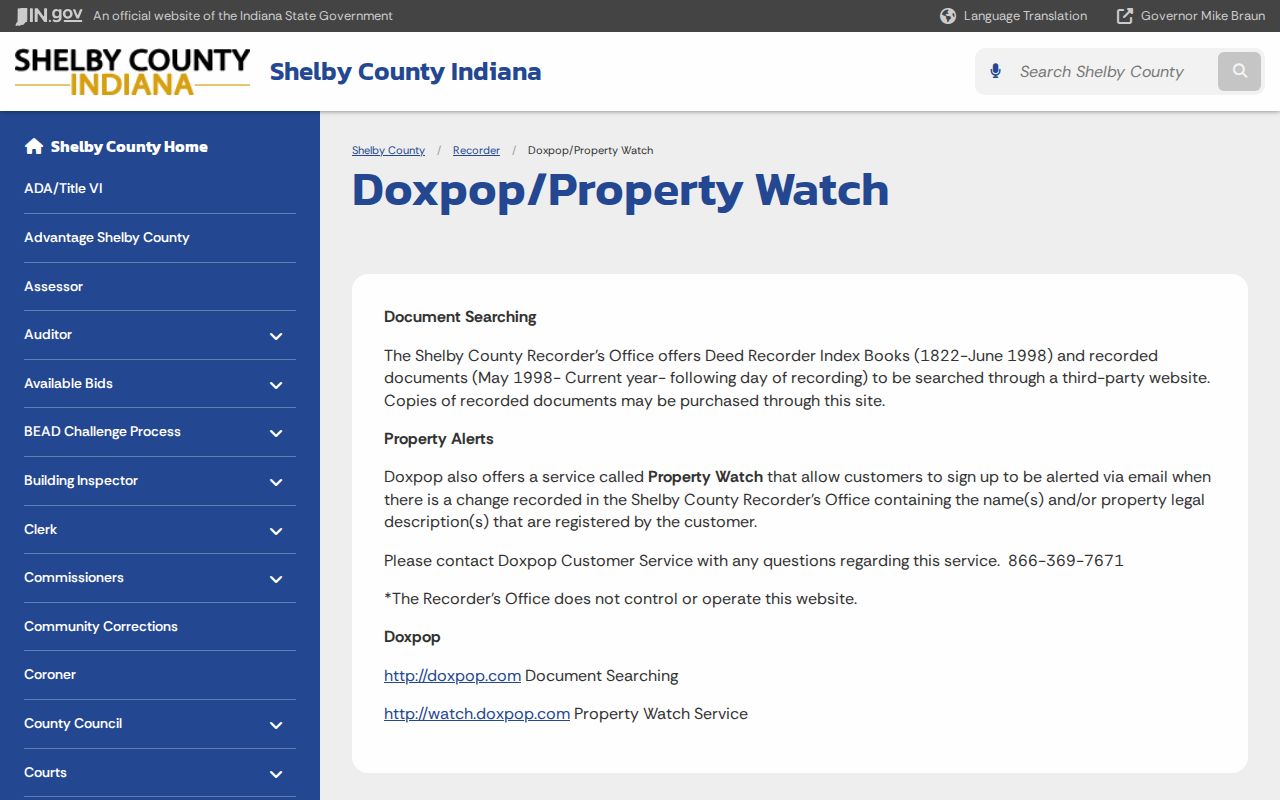
The county capture shows why recorded proof follows the faster assessment search.
Trace Entity and Trust Owners in Shelby County
An assessment hit may list an entity as the owner of record. That can be an LLC, corporation, trustee, estate, or life tenant. Take the exact entity name to Indiana INBiz. Its search fields cover business name, ID, filing, agent, person, type, status, and address. Treat a registered agent's address as a filing clue only. It says nothing about who lives there.
For trusts and estates, read the deed itself. Look for representative capacity, vesting language, and a legal description matching the parcel number. A probate docket can explain a gap in ownership. Still, the recorded deed, affidavit, or similar instrument settles the question. That is the land-record step in Shelby County.
- Owner of record
- The name on the current assessment roll.
- Grantee
- The party receiving an interest by deed.
- Vesting
- The form in which the deed states ownership.
- Situs
- The physical property address, separate from owner mail.
When Shelby County Owner Records Disagree
Timing explains most ownership disagreements in Shelby County. A fresh deed can surface in Doxpop the day after closing. XSoft results carry snapshot dates of their own. The county promises no fixed lag between recording and the assessment roll refresh. So the rolls often trail the deed records. To settle the question, match the legal description on the newest deed. Then ask the Auditor when the ownership update will post. The Assessor covers characteristics and value; the Auditor owns the name of record. Note: Check the date on the individual XSoft result. It can differ from the date shown on the portal landing page.
Monitor New Shelby County Ownership Filings
Doxpop Property Watch sends an email when a name or legal description you register shows up in a new filing. It runs as a fraud-awareness aid, not title certification. Doxpop, not the Recorder, operates the service. Confirm the exact terms first, then use the Property Watch signup.
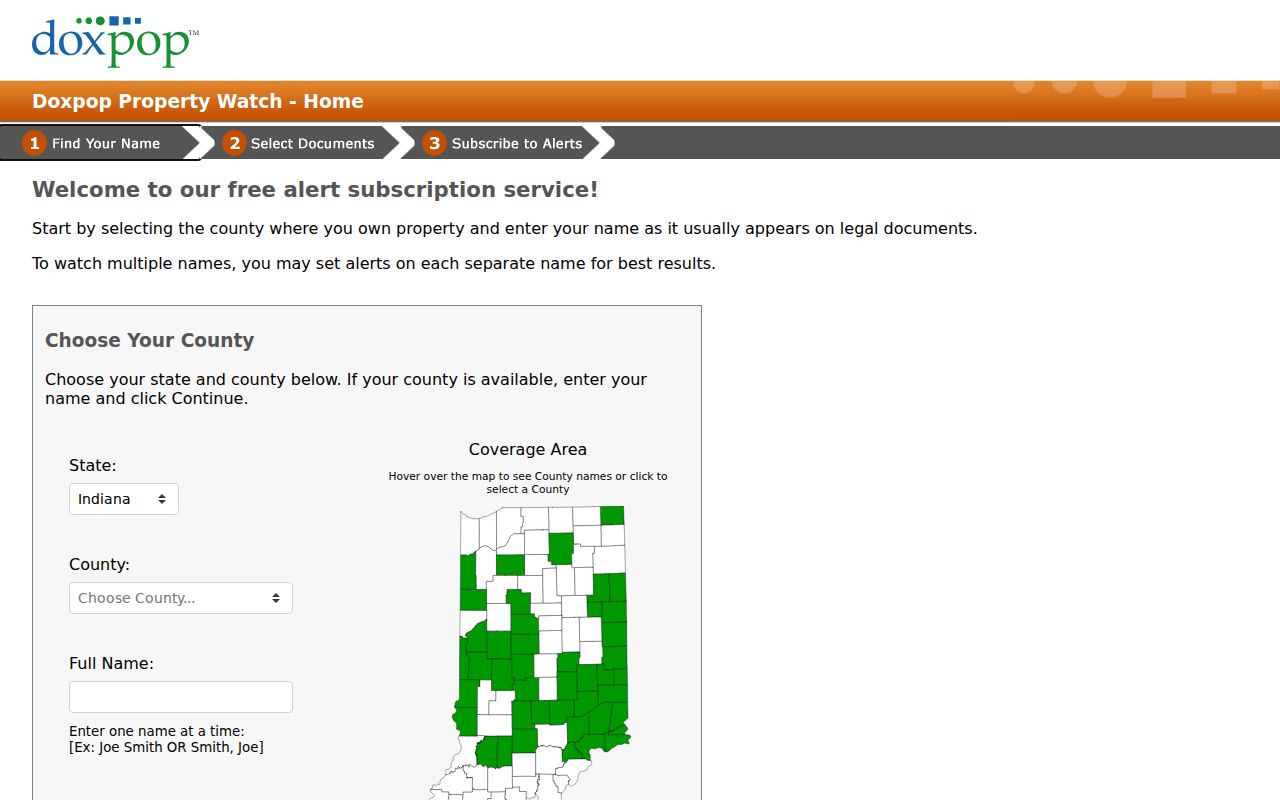
An alert points to a filing; the underlying document still needs review.
Older Shelby County Owner Clues
When the deed trail runs thin, the public library's genealogy department offers older Shelby County owner clues. Its holdings include more than 3,500 family and history folders. You will also find obituary books from 1850, newspapers dating to 1853, city directories, and plat maps. These can separate heirs, trace prior names, and pin down old addresses. They prove nothing about title, though. Use them to sharpen your query. Then go back to the Recorder's instruments; the current-owner page details the present roll-to-deed check.
Limits of a Shelby County Ownership Lookup
A Shelby County ownership lookup has firm limits. A name on the tax roll does not certify title. It also will not reveal every unrecorded interest, prove who lives there, or untangle trust and estate rights, and Indiana Code 36-1-8.5 can restrict covered names or addresses in public databases.
Owner clue, not title opinion. Use Shelby County ownership records for lawful property diligence. Never use owner information to harass, intimidate, or harm anyone.
Public records do not settle every ownership question. That is when qualified title or legal help earns its fee. The Recorder's posted schedule charges $1 for a small copy page. Certification costs $5. Confirm the current charge and the exact instrument before you order anything. When the newest deed image is missing online, treat that gap carefully. Use the counter or a focused copy request instead of assuming no transfer exists.
A short source log keeps every owner search honest. Write down the address you entered, the parcel number returned, and the result date. Also write down the exact Ownership text you saw. Add the newest deed reference you reviewed. If a name differs between county systems, keep both spellings. Compare the legal description before deciding they belong to one party. Small discrepancies are common in Shelby County records. They rarely mean what they first appear to mean.
When an online search dead-ends, the custodian is still the fallback. The Recorder researches and copies instruments, including older manual material. The Auditor handles tax-roll ownership. The Assessor explains property-card characteristics. The Clerk can help locate a probate or court file that may explain the transfer. Indiana APPA lets you frame a focused request for an identifiable public record. That request remains subject to lawful restrictions and redactions.